
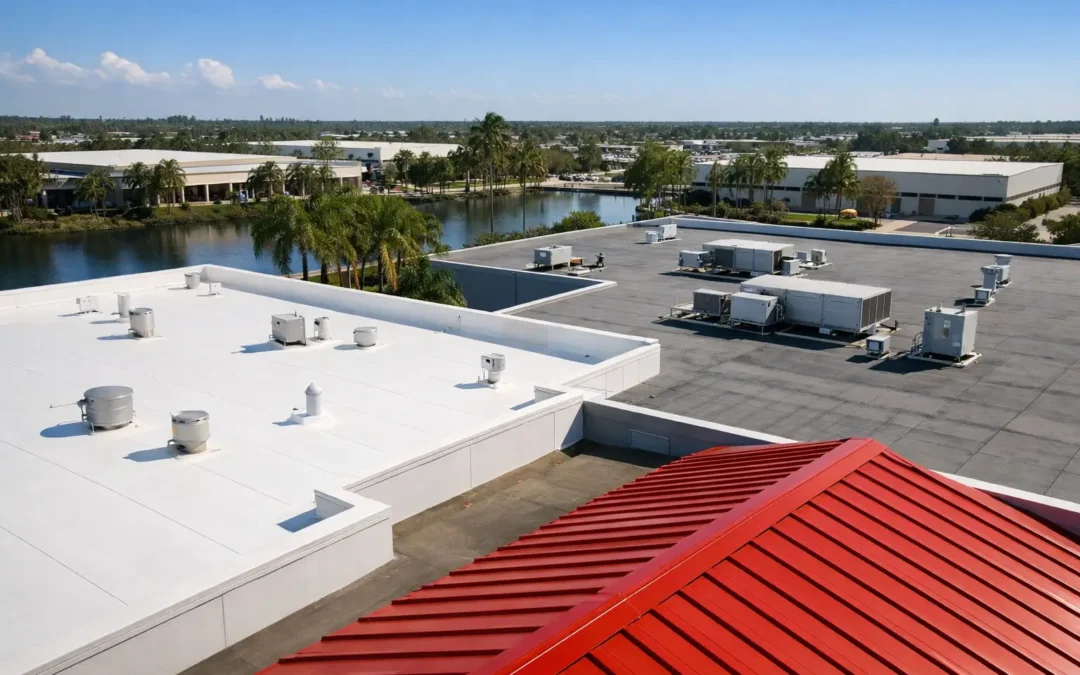
A commercial roof in Northeast Florida has to do more than keep water out. It must handle punishing sun, heavy afternoon rain, humid conditions, standing water risks, and the wind forces that arrive with tropical storms. The best commercial roofing systems are not simply the ones with the longest advertised lifespan. They are the systems that fit the building, its drainage design, daily use, budget, and long-term maintenance plan.
For a retail center, warehouse, office building, apartment community, or church, choosing the wrong roof can create expensive disruption long before the roof reaches the end of its expected service life. The right decision starts with understanding how each system performs under Florida conditions.
What Makes a Commercial Roof Right for Your Property?
Commercial buildings are not all roofed the same way. A low-slope warehouse roof faces different challenges than a steep-slope office building, and a restaurant with rooftop equipment has different service needs than a multi-family property. Material matters, but installation quality, flashing details, insulation, drainage, and maintenance often determine whether a roof delivers its full value.
Before selecting a system, property owners and managers should consider the roof slope, square footage, deck condition, drainage layout, foot traffic, rooftop HVAC equipment, local wind requirements, and whether the building needs to remain fully operational during construction. A roof that looks cost-effective at installation can become the more expensive choice if it requires frequent repairs or offers little protection from heat gain.
In Jacksonville and throughout Florida, wind resistance and water management deserve special attention. Wind-driven rain can find weak seams, poorly secured edge metal, open penetrations, and aging flashing. Even a premium membrane cannot compensate for poor workmanship around drains, curbs, parapet walls, and transitions.
Best Commercial Roofing Systems for Florida Buildings
TPO Roofing
Thermoplastic polyolefin, commonly called TPO, is one of the most widely selected commercial roofing membranes for low-slope buildings. Its light-colored surface reflects a significant amount of solar heat, which can help reduce rooftop temperatures and support better energy performance in Florida’s long cooling season.
TPO is heat-welded at the seams rather than relying only on adhesive. When installed correctly, those welded seams create a strong, continuous waterproof barrier. This makes TPO a practical option for large flat or low-slope roofs, including offices, warehouses, medical buildings, and shopping centers.
The trade-off is that TPO quality depends heavily on the specific product and installation details. Membrane thickness, fastening patterns, edge securement, insulation attachment, and flashing work all affect performance. A lower initial price should not be the only deciding factor. Ask how the system will be designed for wind uplift, how rooftop penetrations will be flashed, and what warranty coverage applies.
PVC Roofing
PVC is another single-ply membrane system well suited to many commercial properties. Like TPO, it has heat-welded seams and is commonly available in reflective white. PVC is particularly valued for its resistance to grease, oils, and many chemicals, making it a strong candidate for restaurants, commercial kitchens, and buildings with certain industrial exposures.
For Florida property owners, PVC offers durable waterproofing and good solar reflectivity. It can carry a higher upfront cost than some TPO systems, but that cost may be justified when the building’s use calls for additional chemical resistance or when a long-term, professionally maintained system is the goal.
PVC still requires careful installation. A membrane is only as reliable as its seams, transitions, drains, and perimeter details. Routine inspections are also wise, especially after severe weather or when contractors access rooftop equipment.
Modified Bitumen Roofing
Modified bitumen is a proven asphalt-based roofing system used on low-slope commercial buildings. It is typically installed in multiple layers, providing redundancy that many property managers appreciate. Depending on the product and design, modified bitumen may be installed with adhesives, heat welding, cold-process materials, or self-adhered sheets.
Its layered construction can make it a dependable choice for roofs with frequent foot traffic or complex details. Maintenance teams, HVAC technicians, and other service providers can place stress on a roof over time, and a properly designed modified bitumen system can offer good puncture resistance.
The system is not automatically the best choice for every building. Darker surfaces can absorb more heat unless a reflective coating or cap sheet is used, and installation approaches must be selected carefully for the property. For buildings where odor, open flame, or occupant disruption is a concern, the contractor should explain the installation method before work begins.
Metal Roofing
Metal roofing is often an excellent fit for commercial buildings with steeper roof slopes, visible rooflines, or a long-term ownership horizon. Standing seam metal panels can provide a clean appearance, strong wind performance when properly engineered, and decades of service with appropriate maintenance.
Metal is not limited to appearance. Its ability to shed water quickly is a major advantage on sloped roofs, and many systems can be designed to support solar integration. For property owners considering energy improvements, roof replacement can be the right time to evaluate a coordinated roofing and solar plan rather than treating them as separate projects.
However, metal roofs require precise panel layout, flashing, fastener placement, and expansion detailing. Florida’s heat causes materials to expand and contract, so installers must allow for movement without creating leak points. Corrosion resistance is also a serious consideration near coastal areas, where salt air can accelerate wear on unsuitable materials or exposed components.
Asphalt Shingles and Tile for Steep-Slope Commercial Roofs
Not every commercial property has a flat roof. Professional offices, retail storefronts, clubhouses, churches, and multi-family buildings may have steep-slope roof designs where architectural shingles, concrete tile, clay tile, or other steep-slope materials make more sense.
Architectural shingles can offer an attractive, cost-conscious solution for suitable buildings, particularly when paired with a complete manufacturer-backed roofing system. Tile offers a distinctive Florida appearance and long service potential, but the structure must be able to support its weight and individual tiles need attention after major wind events.
For either option, the underlayment, flashing, ventilation, and attachment method are as important as the visible roofing material. Missing shingles or cracked tiles are obvious concerns, but water often enters through less visible details around vents, walls, valleys, and penetrations.
The Roof System Includes More Than the Surface
A commercial roof is a complete assembly, not just a membrane, panel, shingle, or tile. Insulation affects energy use and interior comfort. Cover boards can improve durability. Drains, scuppers, gutters, and tapered insulation direct water away from the building. Flashing protects the vulnerable transitions where different building components meet.
This is why a proper commercial roofing estimate should address the full condition of the existing roof. If moisture is trapped in insulation or the deck has deteriorated, installing a new surface over the problem may only delay a larger repair. In some situations, a recover system can be appropriate and reduce project cost. In others, a full tear-off is the safer choice because it allows the contractor to inspect and correct concealed issues.
A dependable contractor will explain that difference clearly rather than recommending the same approach for every property.
Maintenance Protects the Investment
Even the best-installed commercial roof needs regular attention. Leaves, construction debris, and loose material can block drains. Ponding water can stress seams and accelerate deterioration. Foot traffic from service technicians can damage vulnerable areas around HVAC units. Small flashing issues can become interior leaks during a heavy storm.
A practical maintenance plan typically includes scheduled inspections, drain and gutter clearing, checks around penetrations and edge metal, documentation of repairs, and a post-storm review when conditions warrant it. Keeping records also helps property managers budget for future work and respond quickly if a warranty issue arises.
If a leak appears, the goal should be to identify the source rather than repeatedly patch the interior symptom. Water can travel beneath roofing materials or along a deck before it becomes visible inside the building. Prompt professional assessment limits damage to insulation, ceilings, equipment, inventory, and tenant spaces.
Choose Accountability Along With the Material
The strongest commercial roofing system is the one designed for your specific property and installed by a contractor who stands behind the details. Manufacturer credentials, documented workmanship standards, clear warranty options, local storm experience, and responsive repair support should carry real weight in the decision.
Stonebridge helps commercial property owners evaluate roofing needs with the realities of Florida weather in mind, from active leak concerns to planned replacement projects. The best next step is a thorough roof assessment that gives you a clear view of the roof’s condition, practical system options, and the work required to protect the building for years ahead.