
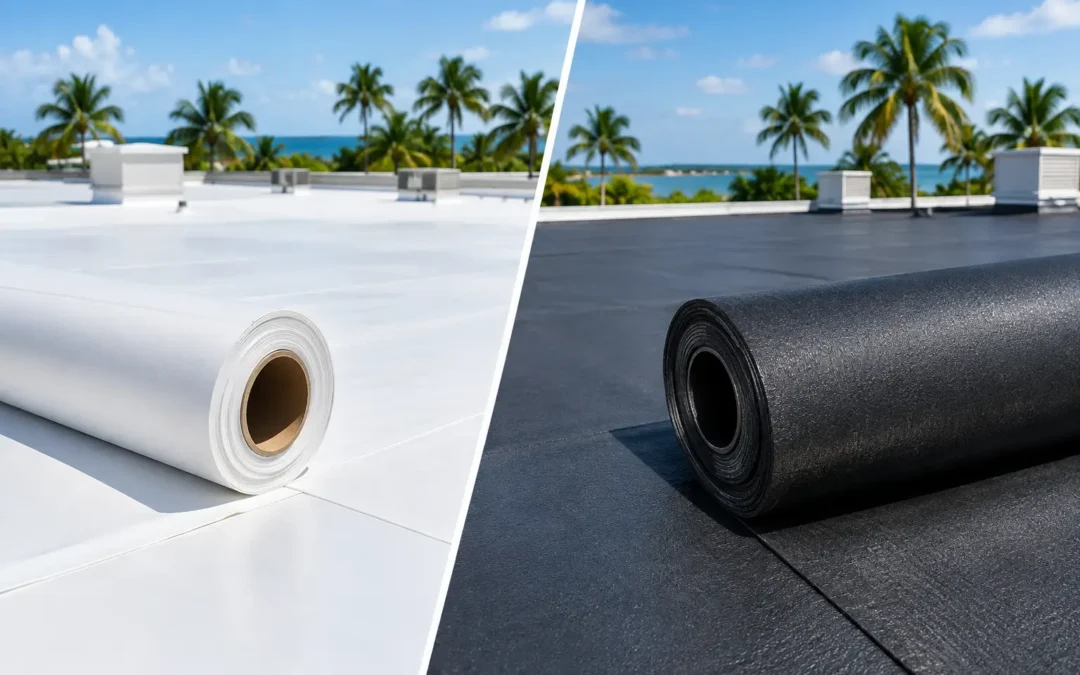
A low-slope roof can look perfectly fine from the ground while seams, flashing, and drainage details are doing all the work overhead. For Florida property owners weighing TPO versus EPDM roofing, the right decision comes down to more than membrane color or initial price. Jacksonville heat, soaking rain, wind-driven storms, standing water, and rooftop equipment all affect how a roofing system performs over time.
Both TPO and EPDM are established single-ply options for commercial buildings, multi-family properties, additions, and other low-slope applications. Each can provide dependable protection when it is properly designed, installed, and maintained. The better choice depends on the building, the roof’s drainage, its exposure to wind, and the owner’s long-term priorities.
TPO Versus EPDM Roofing: The Core Difference
TPO, or thermoplastic polyolefin, is a heat-weldable roofing membrane. Its seams are fused together with hot air during installation, creating a continuous bond. TPO is most often white or light-colored, which makes it a familiar choice for Florida buildings where roof surfaces face intense sun for much of the year.
EPDM, or ethylene propylene diene monomer, is a synthetic rubber membrane. Traditional EPDM is black and uses adhesive, tape, or liquid-applied materials at seams and details rather than heat welding. White EPDM options are also available, though black EPDM remains common in many markets.
Neither membrane is automatically the best fit for every property. A well-installed system with dependable flashing, properly secured edges, and effective drainage will outperform a poorly installed roof, regardless of material.
How Florida Heat and Rain Affect the Choice
Florida’s climate puts different pressures on low-slope roofs at the same time. High surface temperatures can accelerate aging, afternoon storms test drainage, and seasonal hurricanes place major demands on attachment and perimeter details.
TPO in high heat
TPO’s white surface reflects a substantial amount of sunlight compared with a traditional black roof. That can help reduce roof-surface temperatures and may support more manageable cooling demands inside the building. For commercial properties with broad, exposed roof areas, that reflective surface is often a practical advantage.
TPO also performs well when the membrane is installed with carefully welded seams. Because seams are a vulnerable area on any low-slope roof, the consistency of those welds matters. A trained roofing crew should test seams as installation progresses rather than treating quality control as an afterthought.
EPDM in changing weather
EPDM is valued for its flexibility. Rubber membranes can accommodate normal movement from changing temperatures, which can be helpful on buildings with complex transitions or roofs that experience regular expansion and contraction.
A black EPDM membrane absorbs more heat than a white TPO roof, however. That does not make it unsuitable for Florida, but it is a factor to consider on highly exposed buildings. White EPDM can address reflectivity concerns, although material availability, system design, and budget should all be discussed before selecting it.
Florida rain creates another shared concern: drainage. Neither TPO nor EPDM should be expected to solve recurring ponding water caused by inadequate slope, clogged drains, or undersized scuppers. Water that sits on a roof can stress seams, flashing, and penetrations over time. Before replacing a membrane, a qualified contractor should identify why water is collecting there.
Wind Resistance Is About the Full System
During hurricane season, a roof is tested as a system, not as a sheet of membrane. Wind can attack the perimeter, corners, penetrations, edge metal, and transitions long before it affects the open field of the roof.
Both TPO and EPDM can be engineered for strong wind performance. The attachment method may include mechanical fastening, full adhesion, or a specified assembly designed for the building’s needs. What matters is that the roof deck, insulation, membrane, fasteners, seams, flashing, and edge details work together according to the approved design.
Property owners should be cautious of proposals that focus only on membrane thickness or a low per-square-foot price. Those details matter, but a low-slope roof’s ability to endure severe weather also depends on substrate condition, fastening patterns, perimeter securement, and the workmanship around rooftop equipment. A small flaw at a curb or parapet can become a serious leak when rain is driven sideways by high winds.
Installation and Repair Considerations
TPO seams are heat welded, while EPDM seams are typically joined with seam tape or adhesive systems. Both approaches can be reliable, but they demand different installation discipline.
With TPO, proper heat settings, welding speed, and surface preparation are critical. An under-welded or over-welded seam may not perform as intended. With EPDM, clean surfaces and correct primer, tape, and adhesive application are essential. Moisture, dust, and poor preparation can compromise adhesion.
Repairs also differ. TPO repairs usually involve cleaning the membrane and welding a compatible patch. EPDM repairs commonly require cleaning, primer, and compatible patching materials. In either case, the repair should be completed with manufacturer-approved components. Using a generic coating or incompatible sealant may appear to stop a leak temporarily while making a future repair more difficult.
For occupied multi-family and commercial buildings, repair access deserves attention too. Frequent service traffic from HVAC maintenance, plumbing work, and other trades can damage a membrane if walk pads are not used where needed. A roof maintenance plan can catch minor punctures, loose flashing, clogged drains, and deteriorating sealant before they disrupt tenants or operations.
Cost, Service Life, and Long-Term Value
Initial pricing for TPO versus EPDM roofing varies by membrane thickness, insulation needs, roof size, deck repairs, attachment method, tear-off requirements, flashing complexity, and local code requirements. There is no responsible way to name one universal “cheaper” option without inspecting the roof.
TPO can be a strong value for owners who prioritize a reflective roof surface and heat-welded seams. EPDM can be a compelling choice where flexibility, proven rubber-membrane performance, or a particular building condition favors that system. The lowest proposal may leave out critical work such as wet insulation replacement, edge-metal upgrades, drainage corrections, or proper flashing at penetrations.
Service life is equally dependent on installation quality and maintenance. Foot traffic, standing water, storm debris, neglected drains, and delayed repairs can shorten the useful life of either membrane. A detailed estimate should explain what is being replaced, how the roof will be attached, how penetrations will be flashed, and what warranty coverage applies to the completed system.
Which Roofing Material Fits Your Property?
TPO is often a strong candidate for Florida commercial and multi-family roofs with large exposed areas, particularly when a light-colored reflective surface and heat-welded seams align with the property’s goals. EPDM may be appropriate when the building’s configuration, movement, existing system, or project specifications favor a rubber membrane assembly.
The decision becomes more specific when a roof has active leaks, drainage problems, storm damage, aging insulation, or multiple rooftop penetrations. In those situations, choosing between TPO and EPDM without a full assessment can overlook the issue that caused the roof to fail in the first place.
A professional roof evaluation should include the membrane condition, seams, flashing, drainage pathways, deck and insulation condition, rooftop curbs, edge details, and signs of moisture intrusion. For Jacksonville-area owners, it should also account for the wind exposure and storm readiness required for the property.
Stonebridge approaches low-slope roofing as a protection decision, not just a material selection. A clear estimate and a properly specified system give owners a better basis for protecting the building, the people inside it, and the investment it represents. Before the next heavy rain exposes a small roof concern, have the full system evaluated and address the details that keep water where it belongs – outside.